BLOGGER TEMPLATES AND TWITTER BACKGROUNDS »

Saturday, January 8, 2011

The Blitz Kids


The Blitz Kids were a group of unknown people that frequented the Blitz nightclub in the early 1980s. Among their number were Steve Strange, Leigh Bowery, Boy George,  Marilyn, Princess Julia, Philip Sallon, Carl Teper and Martin Degville.

The Blitz Kids had found themselves bored with the whole punk genre and, in an effort to find something new, took to wearing bizarre home-made costumes and clothing and excessive amounts of make-up. They were often extremely androgynous in nature.

Steve Strange and Boy George later became famous in their own right with their musical outings Visage and Culture Club respectively. Boy George celebrated the Blitz

Blitz as a venue was around for a long time before Steve Strange days, it was originally a World War 2 themed wine bar.  
The club was a platform for new talent.  Apart from the fashion crowd, there was jounalist Robert Elms, who wrote  about the scene, and photographers Gabor Scott and David Johnson who recorded the visuals for posterity. Ben Kelly, who went on to desigh the Hacienda in Mahcester, was part of the crowd. 
The brilliant thing was that everyone involved had a role.  George was in the cloacroom in his white-faced kabuki made-up and kimono, Rusty, in his fifties suits, played the records, and I was on the door in my high hair and high heels, carrying a silver-topped cane.  I only every tried DJing once, on a night when I tried to set up a kind of cafe society, playing Shirley Bassey, Dusty Springfield,  Frank Sinatra and escalator background music


Monday, August 30, 2010

Art Deco

Art Deco is an eclectic artistic and design style which had its origins in Paris in the first decades of the 20th century. The style "originated in the twenties, embraced influences from many different styles and movements of the early 20th century, including Neoclassical, Constructivism, Cubism, Modernism, and Futurism.


                                                    Below, left to right, row by row: Carolina Herrera, Hussein Chalayan,
                                       Alberta Ferretti, Proenza Schouler, Hussein Chalayan, Alberta Ferretti, Etro, Chloe


Art Deco has being an inspiration thourghout the decades, in fashion,  architecture, jewelry  and interior .


Chanel collection


Armani


Holly Furton

Monday, August 23, 2010

Pop Art as an inspiration

 Roy Lichtenstein

Pop Art was a visual art movement that emerged in the 1950s in Britain and the United States. The origin of the term Pop Art is unknown but is often credited to British art critic Lawrence Alloway in an essay titled "The Arts and the Mass Media", although he uses the words "popular mass culture" instead of "pop art". Alloway was one of the leading critics to defend Pop Art as a legitimate art form.


                                                            David Hockney, Mr. and Mrs. Clark and Percy


 It was one of the biggest art movements of the twentieth century and is characterized by themes and techniques drawn from popular mass culture, such as television, movies, advertising and comic books. Pop art is widely interpreted as either a reversal or reaction to Abstract Expressionism or an expansion upon it.


   Andy Warhol

The movement was marked by clear lines, sharp paintwork and clear representations of symbols, objects and people commonly found in popular culture. It allowed for large scale artworks like Abstract Expressionism, but drew upon more DADAist elements. DADAism explored some of the same topics, but pop art replaced the destructive, satirical, and anarchic elements of the Dada movement with a reverence for mass culture and consumerism.


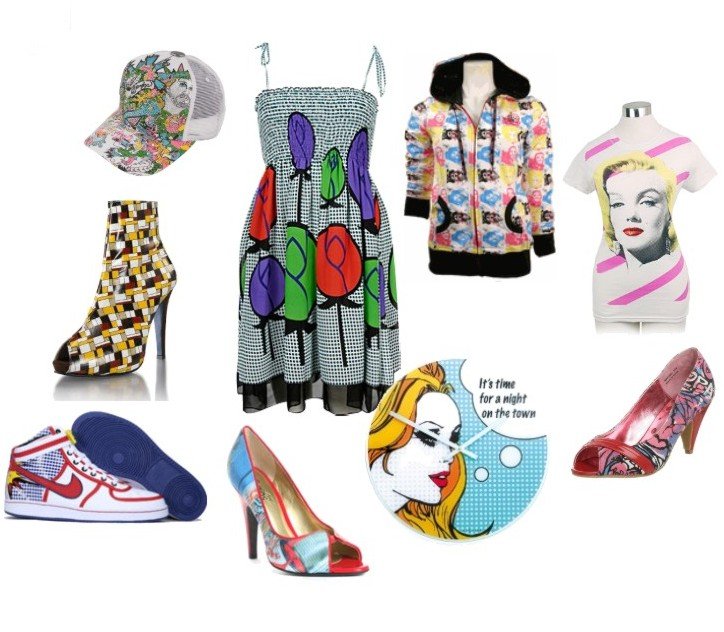
                          CLOTHING INSPIRED BY POP ART


Yves Saint Laurent


Andy Warhol inpired dresses

Jean Charles de Castelvajac


Mickey Mouse sneakers Jeremy Scott x Adidas


Friday, August 20, 2010

Corset

A garment of luxury and sacrifice,that is was essential to highlight woman´s breast , mold and shape the torso.


In the early 1800s, corsets were seen as undergarments of support for women and girls as young as four. Women were considered extremely fragile and corsets were thought to keep them standing upright. Organs became so deformed by the time girls hit their teens that they could not sit or stand properly without the aid of a boned corset. This is where Hollywood got the idea that women fainted often; but it wasn’t because of frailty but rather the inability to draw deep breaths of air. The higher a woman was in society, the tighter her garments were. Servants and working women didn’t wear them every day because their constraint made it hard to do even the mildest labor. And a loose corset was usually the sign of a promiscuous woman.

Nowadays corsets are a symbol of seduction, comfort. An exotic and erotic garment.


Issey Miyakes 1980 Autumn/Winter collection


Thierry Mugler, spring and summer 1992

Dolce & Gabbana, spring and summer 2007

Jean Paul Gaultier-Madonna-1990

Lady Gaga wearing a studded corset with some firelights


Dita Von Teese


Thursday, August 19, 2010

The little black dress

THE RULE OF FASHION


An affordable and versatile dress that can be worn for every ocassion, from casual to cocktail, A dress that will always be in style, and an important piece for every woman´s wardrobe. Fashion historians ascribe the origins of the little black dress to the 1920s designs of Coco Chanel.

Famous Little Black Dress


Portrait of Madame X


Betty Boop


Coco Chanel


Audrey Hepburn (The Breakfast at Tiffany´s)